Friday, 5 August 2016

List of Test cricket hat-tricks and some of the hat-trick trivia

In the sport of cricket, a hat-trick is an occasion where a bowler takes three wickets in consecutive deliveries. As of 5 August 2016, this rare feat has been achieved 42 times in over two thousand Test matches, the form of the sport in which national representative teams compete in matches of up to five days' duration. The first Test hat-trick was recorded on 2 January 1879, in only the third Test match to take place, by the Australian pace bowler Fred Spofforth, nicknamed "The Demon Bowler", who dismissed three English batsmen with consecutive deliveries at the Melbourne Cricket Ground. The most recent bowler to achieve the feat was Sri Lankan spin bowler Rangana Herath against Australia on 5 August 2016. At least one bowler from each of the ten nations that play Test cricket has taken a Test hat-trick


A player has taken two hat-tricks in the same Test match only once. Playing for Australia against South Africa in the first match of the 1912 Triangular Tournament at Old Trafford, Manchester, England, leg spinner Jimmy Matthews took a hat-trick in South Africa's first and second innings, both taken on 28 May 1912. He completed both hat-tricks by dismissing South Africa's Tommy Ward.Only three other cricketers have taken more than one Test hat-trick: 

Australian off spinner Hugh Trumble (two years apart, between the same teams at the same ground), Pakistani fast bowler Wasim Akram (just over a week apart, in consecutive matches between the same teams) and Englishfast bowler Stuart Broad. Three players have taken a hat-trick on their Test debut: English medium pace bowler Maurice Allom in 1930, New Zealand off-spinner Peter Petherick in 1976, and Australian pace bowler Damien Fleming in 1994.Geoff Griffin took the fewest total Test wickets of any player who recorded a hat-trick, taking only eight wickets in his entire Test career.

During the match in which he took his hat-trick, Griffin was repeatedly called for throwing by the umpires and never bowled again in a Test match.Australian Peter Siddle is the only bowler to take a hat-trick on his birthday, and Bangladeshi off spinner Sohag Gazi is the only player to score a century and take a hat-trick in the same Test match.

Australian Merv Hughes is the only bowler to take a hatrick where the wickets fell over three overs. He took a wicket with the final ball of an over. With the first ball of the next over he took the final wicket of the West Indies innings. He then removed the opener Gordon Greenidge with the first ball of the West Indies second innings.


In the five-match series between a Rest of the World XI and England in 1970, a hat-trick was taken by South African Eddie Barlow in the fourth match, at Headingley (the last three of four wickets in five balls).These matches were considered to be Tests at the time, but that status was later removed.
List of Test cricket hat-tricks
No.BowlerForAgainstInn.TestDismissalsVenueDateRef.
1Fred Spofforth Australia England11/1
  • Vernon Royle (b)
  • Francis MacKinnon (b)
  • Tom Emmett (c Tom Horan)
Melbourne Cricket GroundMelbourne2 January 1879
2Billy Bates England Australia12/3
  • Percy McDonnell (b)
  • George Giffen (c and b)
  • George Bonnor (c Walter Read)
Melbourne Cricket GroundMelbourne20 January 1883
3Johnny Briggs England Australia22/3
  • Walter Giffen (b)
  • Jack Blackham (lbw)
  • Sydney Callaway (c W. G. Grace)
Sydney Cricket Ground,Sydney2 February 1892
4George Lohmann England South Africa21/3
  • Frederick Cook (b)
  • Bonnor Middleton (b)
  • Joseph Willoughby (cTom Hayward)
St. George's ParkPort Elizabeth14 February 1896
5Jack Hearne England Australia23/5
  • Clem Hill (b)
  • Syd Gregory (c Archie MacLaren)
  • Monty Noble (cRanjitsinhji)
HeadingleyLeeds30 June 1899
6Hugh Trumble Australia England22/5
  • John Gunn (c Sammy Jones)
  • Arthur Jones (c Joe Darling)
  • Sydney Barnes (c and b)
Melbourne Cricket GroundMelbourne4 January 1902
7Hugh Trumble Australia England25/5
  • Bernard Bosanquet (cAlgy Gehrs)
  • Plum Warner (c and b)
  • Dick Lilley (lbw)
Melbourne Cricket GroundMelbourne8 March 1904
8Jimmy Matthews Australia South Africa11/3
  • Rolland Beaumont (b)
  • Sid Pegler (lbw)
  • Tommy Ward (lbw)
Old Trafford,Manchester28 May 1912
9Jimmy Matthews Australia South Africa21/3
  • Herbie Taylor (b)
  • Reggie Schwarz (c and b)
  • Tommy Ward (c and b)
Old Trafford,Manchester28 May 1912
10Maurice Allom England New Zealand11/4
  • Tom Lowry (lbw)
  • Ken James (c Tich Cornford)
  • Ted Badcock (b)
Lancaster Park,Christchurch10 January 1930
11Tom Goddard England South Africa11/5
  • Dudley Nourse (c and b)
  • Norman Gordon (stLeslie Ames)
  • Billy Wade (b)
Old Wanderers,Johannesburg26 December 1938
12Peter Loader England West Indies14/5
  • John Goddard (b)
  • Sonny Ramadhin (c Fred Trueman)
  • Roy Gilchrist (b)
HeadingleyLeeds25 July 1957
13Lindsay Kline Australia South Africa22/5
  • Eddie Fuller (c Richie Benaud)
  • Hugh Tayfield (lbw)
  • Neil Adcock (c Bob Simpson)
NewlandsCape Town3 January 1958
14Wes Hall West Indies Pakistan13/3
  • Mushtaq Mohammed(lbw)
  • Fazal Mahmood (cGarfield Sobers)
  • Nasim-ul-Ghani (b)
Bagh-e-JinnahLahore29 March 1959
15Geoff Griffin South Africa England12/5
  • M. J. K. Smith (c John Waite)
  • Peter Walker (b)
  • Fred Trueman (b)
Lord's, London24 June 1960
16Lance Gibbs West Indies Australia14/5
  • Ken Mackay (lbw)
  • Wally Grout (c Garfield Sobers)
  • Frank Misson (b)
Adelaide OvalAdelaide30 January 1961
17Peter Petherick New Zealand Pakistan11/3
  • Javed Miandad (cRichard Hadlee)
  • Wasim Raja (c and b)
  • Intikhab Alam (c Geoff Howarth)
Gaddafi Stadium,Lahore9 October 1976
18Courtney Walsh West Indies Australia1 & 21/5
  • Tony Dodemaide (c Viv Richards)
  • Mike Veletta (c Carl Hooper)
  • Graeme Wood (lbw)
Brisbane Cricket GroundBrisbane18–20 November 1988
19Merv Hughes Australia West Indies1 & 22/5
  • Curtly Ambrose (c Ian Healy)
  • Patrick Patterson (c Tony Dodemaide)
  • Gordon Greenidge (lbw)
WACAPerth3–4 December 1988
20Damien Fleming Australia Pakistan22/3
  • Aamer Malik (c Michael Bevan)
  • Inzamam-ul-Haq (lbw)
  • Saleem Malik (c Ian Healy)
Rawalpindi Cricket StadiumRawalpindi9 October 1994
21Shane Warne Australia England22/5
  • Phil DeFreitas (lbw)
  • Darren Gough (c Ian Healy)
  • Devon Malcolm (c David Boon)
Melbourne Cricket GroundMelbourne29 December 1994
22Dominic Cork England West Indies24/6
  • Richie Richardson (b)
  • Junior Murray (lbw)
  • Carl Hooper (lbw)
Old Trafford,Manchester30 July 1995
23Darren Gough England Australia15/5
  • Ian Healy (c Warren Hegg)
  • Stuart MacGill (b)
  • Colin Miller (b)
Sydney Cricket Ground,Sydney2 January 1999
24Wasim Akram Pakistan Sri Lanka13/4
  • Romesh Kaluwitharana(c Moin Khan)
  • Niroshan Bandaratilleke(b)
  • Pramodya Wickramasinghe (b)
Gaddafi Stadium,Lahore6 March 1999
25Wasim Akram Pakistan Sri Lanka24/4
  • Avishka Gunawardene (cShahid Afridi)
  • Chaminda Vaas (b)
  • Mahela Jayawardene (cWajahatullah Wasti)
Bangabandhu National StadiumDhaka14 March 1999
26Nuwan Zoysa Sri Lanka Zimbabwe12/3
  • Trevor Gripper (lbw)
  • Murray Goodwin (cRomesh Kaluwitharana)
  • Neil Johnson (lbw)
Harare Sports Club,Harare26 November 1999
27Abdul Razzaq Pakistan Sri Lanka12/3
  • Romesh Kaluwitharana(c Moin Khan)
  • Rangana Herath (lbw)
  • Ravi Pushpakumara(lbw)
Galle International StadiumGalle21 June 2000
28Glenn McGrath Australia West Indies12/5
  • Sherwin Campbell (cRicky Ponting)
  • Brian Lara (c Stuart MacGill)
  • Jimmy Adams (c Justin Langer)
WACAPerth1 December 2000
29Harbhajan Singh India Australia12/3
  • Ricky Ponting (lbw)
  • Adam Gilchrist (lbw)
  • Shane Warne (cSadagoppan Ramesh)
Eden GardensCalcutta11 March 2001
30Mohammad Sami Pakistan Sri Lanka13/3
  • Charitha Buddhika (lbw)
  • Nuwan Zoysa (lbw)
  • Muttiah Muralitharan (b)
Gaddafi Stadium,Lahore8 March 2002
31Jermaine Lawson West Indies Australia1 & 23/4
  • Brett Lee (b)
  • Stuart MacGill (b)
  • Justin Langer (lbw)
Kensington Oval,Bridgetown2–5 May 2003
32Alok Kapali Bangladesh Pakistan12/3
  • Shabbir Ahmed (cMashrafe Mortaza)
  • Danish Kaneria (lbw)
  • Umar Gul (lbw)
Arbab Niaz Stadium,Peshawar29 August 2003
33Andy Blignaut Zimbabwe Bangladesh21/2
  • Hannan Sarkar (lbw)
  • Mohammad Ashraful (csub (Travis Friend))
  • Mushfiqur Rahman (cTatenda Taibu)
Harare Sports Club,Harare22 February 2004
34Matthew Hoggard England West Indies23/4
  • Ramnaresh Sarwan (cAshley Giles)
  • Shivnarine Chanderpaul(lbw)
  • Ryan Hinds (c Andrew Flintoff)
Kensington Oval,Barbados3 April 2004
35James Franklin New Zealand Bangladesh11/2
  • Manjural Islam Rana (cBrendon McCullum)
  • Mohammad Rafique (cScott Styris)
  • Tapash Baisya (b)
Bangabandhu National StadiumDhaka20 October 2004
36Irfan Pathan India Pakistan13/3
  • Salman Butt (c Rahul Dravid)
  • Younis Khan (lbw)
  • Mohammad Yousuf (b)
National Stadium, Karachi29 January 2006
37Ryan Sidebottom England New Zealand21 /3
  • Stephen Fleming (cAlastair Cook)
  • Mathew Sinclair (cAlastair Cook)
  • Jacob Oram (lbw)
Seddon ParkHamilton8 March 2008
38Peter Siddle Australia England11/5
  • Alastair Cook (c Shane Watson)
  • Matt Prior (b)
  • Stuart Broad (lbw)
Brisbane Cricket GroundBrisbane25 November 2010
39Stuart Broad England India12/4
  • Mahendra Singh Dhoni(c James Anderson)
  • Harbhajan Singh (lbw)
  • Praveen Kumar (b)
Trent Bridge,Nottinghamshire30 July 2011
40Sohag Gazi Bangladesh New Zealand21/2
  • Corey Anderson (lbw)
  • BJ Watling (c Mushfiqur Rahim)
  • Doug Bracewell (cShakib Al Hasan)
Zahur Ahmed Chowdhury Stadium,Chittagong13 October 2013
41Stuart Broad England Sri Lanka12/2
  • Kumar Sangakkara (cIan Bell)
  • Dinesh Chandimal (cAlastair Cook)
  • Shaminda Eranga (cMatt Prior)
HeadingleyLeeds20 June 2014
42Rangana Herath Sri Lanka Australia12/3
  • Adam Voges (c Dimuth Karunaratne)
  • Peter Nevill (lbw)
  • Mitchell Starc (lbw)
Galle International StadiumGalle5 August 2016
England and Australia combined have taken over half of all Test match hat-tricks to date, 24 of 42 (58.53%)
Test hat-tricks by team
TeamHat-tricks
 England13
 Australia11
 Pakistan4
 West Indies4
 Bangladesh2
 India2
 Sri Lanka2
 New Zealand2
 South Africa1
 Zimbabwe1
Source : en.wikipedia.org

Below are some of the hat-trick trivia:

Harbhajan Singh, Darren Gough, Broad and Nuwan Zoysa are the only players to have taken a hat-trick in Tests and have been victims of a bowler’s hat-trick too.
Most number of hat-tricks in Tests have been taken by England (13) and the most number of hat-tricks taken against a team also is by England (8).

Damien Fleming, Peter Petherick and Maurice Allom took a hat-trick on their Test debut.
The most number of hat-tricks taken in a year is 1999 (4) followed by 2004 (3).

Pakistan have taken four hat-tricks and all of them have come against Sri Lanka.
The longest hat-trick is by Merv Hughes spread across two innings against the West Indies at WACA in 1988-89. His hat-trick was spread over three overs.

Irfan Pathan has taken a hat-trick in the first over of a Test and Zoysa took a hat-trick during the first three balls of the Test.

Courtney Walsh was the first to take hat-trick in split innings at Gabba, Brisbane against Australia in 1988-89, a feat achieved by Hughes of Australia in the very next Test of the series at WACA. Till date, such a feat has been repeated only by Geoff Lawson of Australia.
Tommy Ward was involved in both hat-tricks of Jimmy Matthews and on the same day. So, Matthews is also the only bowler to have taken a hat-trick in the same Test and on the same day, and that came against South Africa in 1912.

Mohammad Sami and Wasim Akram are the only ones to have a Test and a One-Day International (ODI) hat-trick. Akram is the only one to have achieved hat-tricks twice in both formats.

Hugh Trumble and Patherick’s hat-tricks involved catches in all three dismissals with one of them being caught & bowled. The next one to have done that is Broad in the ongoing Test match against Sri Lanka at Headingley.

Matthews’ hat-trick against South Africa in 1912 in the first innings didn’t involve the fielder, as it included one bowled and two lbws. This was next achieved by Dominic Cork with one bowled and two lbws in the second innings against the West Indies at Lord’s in 1995. Others in this list include; Lawson and Sami.


Sohag Gazi is the only bowler to take a hat-trick and score a century in the same Test.


Thursday, 28 July 2016

What is VPN?

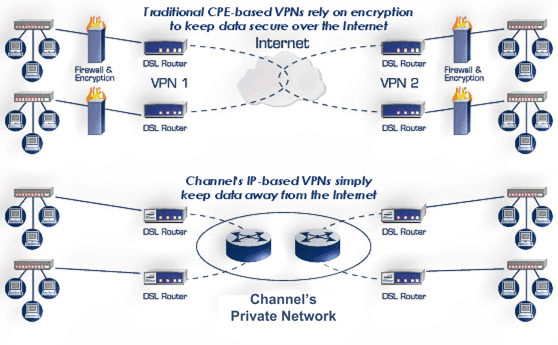
A Virtual Private Network (VPN) is a network technology that creates a secure network connection over a public network such as the Internet or a private network owned by a service provider. Large corporations, educational institutions, and government agencies use VPN technology to enable remote users to securely connect to a private network.
A VPN can connect multiple sites over a large distance just like a Wide Area Network (WAN). VPNs are often used to extend intranets worldwide to disseminate information and news to a wide user base. Educational institutions use VPNs to connect campuses that can be distributed across the country or around the world.
In order to gain access to the private network, a user must be authenticated using a unique identification and a password. An authentication token is often used to gain access to a private network through a personal identification number (PIN) that a user must enter. The PIN is a unique authentication code that changes according to a specific frequency, usually every 30 seconds or so.

Protocols

There are a number of VPN protocols in use that secure the transport of data traffic over a public network infrastructure. Each protocol varies slightly in the way that data is kept secure.
IP security (IPSec) is used to secure communications over the Internet. IPSec traffic can use either transport mode or tunneling to encrypt data traffic in a VPN. The difference between the two modes is that transport mode encrypts only the message within the data packet (also known as the payload) while tunneling encrypts the entire data packet. IPSec is often referred to as a "security overlay" because of its use as a security layer for other protocols.
Secure Sockets Layer (SSL) and Transport Layer Security (TLS) use cryptography to secure communications over the Internet. Both protocols use a "handshake" method of authentication that involves a negotiation of network parameters between the client and server machines. To successfully initiate a connection, an authentication process involving certificates is used. Certificates are cryptographic keys that are stored on both the server and client.
Point-To-Point Tunneling Protocol (PPTP) is another tunneling protocol used to connect a remote client to a private server over the Internet. PPTP is one of the most widely used VPN protocols because of it's straightforward configuration and maintenance and also because it is included with the Windows operating system.
Layer 2 Tunneling Protocol (L2TP) is a protocol used to tunnel data communications traffic between two sites over the Internet. L2TP is often used in tandem with IPSec (which acts as a security layer) to secure the transfer of L2TP data packets over the Internet. Unlike PPTP, a VPN implementation using L2TP/IPSec requires a shared key or the use of certificates.
VPN technology employs sophisticated encryption to ensure security and prevent any unintentional interception of data between private sites. All traffic over a VPN is encrypted using algorithms to secure data integrity and privacy. VPN architecture is governed by a strict set of rules and standards to ensure a private communication channel between sites. Corporate network administrators are responsible for deciding the scope of a VPN, implementing and deploying a VPN, and ongoing monitoring of network traffic across the network firewall. A VPN requires administrators to be continually be aware of the overall architecture and scope of the VPN to ensure communications are kept private.

Advantages & Disadvantages

A VPN is a inexpensive effective way of building a private network. The use of the Internet as the main communications channel between sites is a cost effective alternative to expensive leased private lines. The costs to a corporation include the network authentication hardware and software used to authenticate users and any additional mechanisms such as authentication tokens or other secure devices. The relative ease, speed, and flexibility of VPN provisioning in comparison to leased lines makes VPNs an ideal choice for corporations who require flexibility. For example, a company can adjust the number of sites in the VPN according to changing requirements.
There are several potential disadvantages with VPN use. The lack of Quality of Service (QoS) management over the Internet can cause packet loss and other performance issues. Adverse network conditions that occur outside of the private network is beyond the control of the VPN administrator. For this reason, many large corporations pay for the use of trusted VPNs that use a private network to guarantee QoS. Vendor interoperability is another potential disadvantage as VPN technologies from one vendor may not be compatible with VPN technologies from another vendor. Neither of these disadvantages have prevented the widespread acceptance and deployment of VPN technology.

Friday, 8 July 2016

The Life of Abdul Sattar Edhi


Abdul Sattar Edhi (MemoniUrduعبدالستار ایدھی‎; 1 January 1928 – 8 July 2016) was a prominent Pakistani philanthropistsocial activistascetic, and humanitarian. He was the founder and head of the Edhi Foundation in Pakistan and ran the organization for the better part of six decades. He was known as Angel of Mercy and was considered Pakistan's "most respected figure."[In 2013, The Huffington Post said that he might be "the world's greatest living humanitarian.

Early life
Edhi was born in 1928 in Bantva in the GujaratBritish India. When he was eleven, his mother became paralysed from a stroke and she died when Edhi was 19. His personal experiences and care for his mother during her illness, caused him to develop a system of services for old, mentally ill and challenged people. The partition of India led Edhi and his family to migrate to Pakistan in 1947 .He then shifted to Karachi to work in a market at a wholesale shop. His mother would give him 1 paisa for his meals and another to give to a beggar.[9] He initially started as a peddler, and laterbecame a commission agent selling cloth in the wholesale market in Karachi. After a few years, he established a free dispensary with help from his community
He told NPR in 2009 that "I saw people lying on the pavement ... The flu had spread in Karachi, and there was no one to treat them. So I set up benches and got medical students to volunteer. I was penniless and begged for donations on the street. And people gave. I bought this 8-by-8 room to start my work."

Charity work

Edhi resolved to dedicate his life to aiding the poor, and over the next sixty years, he single handedly changed the face of welfare in Pakistan. Edhi founded the Edhi Foundation, with an initial sum of a five thousand rupees. Regarded as a guardian for the poor, Edhi began receiving numerous donations, which allowed him to expand his services. To this day, the Edhi Foundation continues to grow in both size and service, and is currently the largest welfare organisation in Pakistan. Since its inception, the Edhi Foundation has rescued over 20,000 abandoned infants, rehabilitated over 50,000 orphans and has trained over 40,000 nurses.[citation needed] It also runs more than 330 welfare centres in rural and urban Pakistan which operate as food kitchens, rehabilitation homes, shelters for abandoned women and children and clinics for the mentally handicapped.
The Edhi Foundation, founded by Edhi, runs the world's largest ambulance service (operating 1,500 of them) and offers 24-hour emergency services. It also operates free nursing homes, orphanages, clinics, women's shelters, and rehab centres for drug addicts and mentally ill individuals.[11] It has run relief operations in AfricaMiddle East, the Caucasus region, eastern Europe and United States where it provided aid following Hurricane Katrina in 2005. His son Faisal Edhi, wife Bilquis Edhi and daughters managed the daily operations of the organization during his ill health.[citation needed]
Edhi was influenced by Muhammad Ali Jinnah and Mother Teresa. He was referred as Pakistan's version of Mother Teresa,[12] and the BBC wrote that he was considered "Pakistan's most respected figure and was seen by some as almost a saint."

Recognition

Together with his wife, Bilquis Edhi, he received the 1986 Ramon Magsaysay Award for Public Service. He was also the recipient of the Lenin Peace Prize and the Balzan Prize. In 2006, Institute of Business Administration Pakistan conferred an honoris causa degree of Doctor of Social Service Management for his services. In September 2010, Edhi was also awarded an honorary doctorate by the University of Bedfordshire. In 1989, Edhi received the Nishan-e-Imtiaz from the Government of Pakistan. On 1 January 2014, Edhi was voted the 2013 Person of the Year by the readers of The Express Tribune. He was recommended for a Nobel Peace prize by the Prime Minister of Pakistan with more than 30,000 signing a petition by Ziauddin Yousafzai, the father of Malala Yousafzai for his nomination.

Travel issues

In the early 1980s he was arrested by Israeli troops while entering Lebanon. In 2006, he was detained in Toronto, Canada, for 16 hours. In January 2008, US immigration officials interrogated Edhi at the John F. Kennedy Airport in New York for over eight hours, and seized his passport and other documents. When asked about the frequent detention Edhi said "The only explanation I can think of is my beard and my dress."

Personal life and death

Edhi was married in 1965 to Bilquis, a nurse who worked at the Edhi dispensary. The couple had four children, two daughters and two sons.Edhi was known for his asceticlifestyle, owning only two pairs of clothes and living in an apartment next to his organization's office
On 25 June 2013, Edhi's kidneys failed; it was announced that he would be on dialysis for the rest of his life unless he found a kidney donor. Edhi died on 8 July 2016 at the age of 88 due to kidney failure after having been placed on a ventilator. He will be buried in Edhi Village. His last wishes included the request that his organs were to be donated but due to his ill health, only his corneas were suitable. He will be given a full state funeral.
Reactions to his death came from several high-ranking Pakistani officials. Prime Minister Nawaz Sharif said "We have lost a great servant of humanity. He was the real manifestation of love for those who were socially vulnerable, impoverished, helpless and poor." The country's head of the army, Raheel Sharif, called him a "true humanitarian."

Honors and awards

International awards

  • Ramon Magsaysay Award for Public Service (1986)
  • Lenin Peace Prize (1988)
  • Paul Harris Fellow from Rotary International (1993)
  • Peace Prize from the former USSR, for services during the Armenian earthquake disaster (1998)
  • Hamdan Award for volunteers in Humanitarian Medical Services (2000), UAE
  • International Balzan Prize (2000) for Humanity, Peace and Brotherhood, Italy
  • Peace and Harmony Award (2001), Delhi
  • Peace Award (2004), Mumbai
  • Peace Award (2005), Hyderabad Deccan
  • Wolf of Bhogio Peace Award (2005), Italy
  • Gandhi Peace Award (2007), Delhi
  • Peace Award (2008), Seoul
  • Honorary doctorate from the Institute of Business Administration Karachi (2006).
  • UNESCO-Madanjeet Singh Prize (2009)
  • Ahmadiyya Muslim Peace Prize (2010)

National awards

  • Silver Jubilee Shield by College of Physicians and Surgeons (1962–1987)
  • Moiz ur rehman Award (2015)
  • The Social Worker of Sub-Continent by Government of Sindh (1989)
  • Nishan-e-Imtiaz, civil decoration from the Government of Pakistan (1989)
  • Recognition of meritorious services to oppressed humanity during the 1980's by Ministry of Health and Social Welfare, Government of Pakistan (1989)
  • Pakistan Civic Award from the Pakistan Civic Society (1992)[
  • Shield of Honor by Pakistan Army (E & C
  • Khidmat Award by the Pakistan Academy of Medical Sciences
  • Human Rights Award by Pakistan Human Rights Society
Source: en.wikipedia.org

Thursday, 21 April 2016

WHAT IS INFERTILITY.

Infertility in women is the inability to conceive.
Symptoms :
1) Deposite attempting to do so for more than a year.
2) Provide her a partner has normal reproductive function.
3) irregular menstruation
4) amenorrhea
5) dysmenorrhoea
6) descending pain in breast
7) aches in the waist
WHAT IS PRIMARY INFERTILITY. .....
If a woman has never conceived , it is primary Infertility.
What is SECONDARY INFERTILITY.....
If a women has conceived previously , it is secondary Infertility.
Pattern of infertility and treatment
1) kidney yang deficiency causes infertility with loss of LI biological, delayed and decreased menstruation with pale menses: main symptoms
1) infertility
2) loss of libido
3) delayed menses
4) pale menses
5) aches and weakness of waist and legs
6) dusky complexion
Causes of disease
1) kidney yang become deficient due to :
● inadequate prenatal andowment
● excessive sexual activity
2) the essence then can not gel and form into a fetus
3) cold and humidity gels in chong mo and ren mo and causes blockade there.
4) humidity fills the uterine meridians, so that essence can not gel form into a fetus .
Treatment :
Group 1: K 3, 7, CV 4, 6, GV 4, UB 23, 47 tone
After 3 months stop thus treatment. given below treatment for kidney essence deficiency
Group 2: K 3, 6, CV 4, GV 4, 14, 20, UB 11, 15, 23, GB 39 tone
Given this treatment for 3 months. After this again given treatment according to group 1 for 3 months.
2) kidney yin deficiency causes infertility with early and decreased menses with evacuation and five palm heat:
Main symptoms :
1) infertility
2) early menses
3) decreased menses
4) emacition
5) five palm heat
6) blurred vision
Causes of diseased :
1) deficiency of kidney yin allow yang QI to be overactive .
2) increase yang QI raises internal heat. This internal heat goes to ren and chong mo.
3) inadequate prenatal endowment may also causes kidney yin deficiency and consequent infertility.
Treatment :
Group 1: K2, H 5, LU 10, sedated
K 3, 6, 9, 10, SP 6, CV 4, UB 23, LU 7, tone
Given this treatment for 3 months. After 3 months given following treatment for deficiency of kidney essence .
Group 2: K 3, 6, CV 4, GV 4, 14, 20, UB 11, 15, 23, GB 39 tone
3) stagnation of liver qi may causes infertility with premenstrual breast distension, decreased and dark coloured menses containing clots or irregular menses :
Main symptoms :
1) infertility
2 ) premenstrual breast distension
3) decreased and dark coloured menses containing clots
4) irregular menses
Treatment :
Group 1: CV 3, 4, 6, LIV 3 SEDATE
Group 2 : P 6, TW 6 GB 34, LIV 3, 13, 14 SEDATE
4) accumulating of internal humid phlegm due to deficiency of spleen causes infertility with delayed menses or amenorrhea , leukorrhea and weight gain : main symptoms :
1 ) infertility
2) delayed menses
3 ) amenorrhea - copious and viscid vaginally discharge
4) obesity
5) chest tightness
Causes of disease :
1) excess consumption of fatty and spicy foods and in obesity humidity and phlegm accumulate in the interior and obstruct qi movement.
2) reduced qi movement causes loss of control of ren and chong mo .
3) there is overflow of fat in the uterine channels.
4) it impairs uterine function.
Treatment : SP 6, 9, ST 40, CV 6, 4 sedate .
5) Statis of blood in the uterus causes infertility with delayed and decreased menses or dysmenorrhoea, menstrual blood is dark purple with clots.
Main symptoms :
1) infertility
2) delayed menses with decreased menses
3) dysmenorrhoea may be there
4) menses is of dark purple colour with clots
5) Abdominal pain
Treatment : LIV 3, LI 4, ST 29, CV 6, 4, SP 6, UB 32, 20,sedated. ..
NOTE....
add Fib D 1b & Fat D 1b include all infertility treatment this points will rent by star magnet or state needle
Dr.Sheikh
Andheri west Mumbai